



Table of Contents
Stop the air path and you may stop a surprising amount of noise with it.
Apartment entry doors are busy things. They let you in and out, provide security and may form part of the building's fire-safety system. Unfortunately, some also deliver cold corridor air, voices, lift noise, dust and the smell of somebody else's dinner directly into your apartment.
If you can see light around the door, feel air moving or hear every hallway conversation as though the participants have joined you in your apartment for a chat, the gaps around the door deserve attention.
But apartment doors are not ordinary front doors. Before you buy a seal, or put a drill anywhere near the frame, you need to check three things:
- Is it a fire door?
- Do you need owners corporation or rental-provider approval?
- Is gas being burnt inside the apartment?
Once those questions are resolved, there are excellent ways to improve the door.
Looking at the whole apartment rather than just the door? Start with Smarter, Comfortable Apartments.
First: Is the Noise Actually Coming Through the Door?
Apartment noise can travel in several ways.
- Airborne noise - voices, televisions, barking and lift announcements, can travel through gaps around a door.
- Impact noise - footsteps, chairs scraping and doors slamming, can travel through floors, walls and the building structure.
- Mechanical noise from lifts, pumps and ventilation equipment may also travel through the structure or ductwork.
Door seals help when sound is passing through the air gaps around the door. They cannot stop structural vibration or sound arriving through the walls and ceiling.
Try this simple test when there is some normal activity in the corridor. Stand inside with the door closed and listen near the bottom, latch side, hinge side and top. If voices become much clearer near a particular gap, sealing that air path should help. No need to recruit the neighbours or crouch suspiciously behind the door while they are standing outside. 🤣
Other clues include:
- visible light around the door
- cold air at ankle height
- the door rattling in its frame
- corridor smells entering the apartment
- dust gathering in a line inside the threshold
- whistling on windy days
If most of the noise seems to come straight through the door leaf rather than around it, the door itself may be light or poorly suited to acoustic separation. Seals can still close the gaps, but they cannot add mass to the door.
Three Checks Before You Touch the Door
1. Is It a Fire Door?
Many apartment entry doors are certified fire doors. The door leaf, frame, closer, hinges, latch, clearances and approved seals work together as a fire-door assembly.
Do not drill into, cut, plane, obstruct or otherwise modify an apartment fire door or its frame until the proposed work has been approved by the building or owners corporation manager and confirmed as suitable by an appropriately qualified fire-door professional.
Do not assume it is an ordinary door because you cannot see a label. Ask the building manager to confirm its status.
A fire door must also close and latch correctly. A new seal must never prevent that from happening. And please do not wedge the door open because the closer is annoying. The closer is there for a very good reason.
BAL is not the same as a fire-door approval
Some door seals carry a Bushfire Attack Level, or BAL, rating. That relates to bushfire exposure. It does not automatically mean the product can be added to a certified apartment fire door. Two different fire-safety questions. Two different approval processes.
2. Do You Have Permission?
Even if you own the apartment, the entry door, frame or corridor-facing side may be common property or controlled by owners corporation rules. The building may also require a consistent appearance along the corridor.
Before fitting a permanent product:
- check the plan of subdivision and owners corporation rules
- ask whether the door and frame form part of your lot or common property
- identify the exact product and where it would be installed
- ask for written approval where required
- check whether drilling into the threshold or corridor floor is permitted
If you rent, check whether you need consent from the rental provider as well as the owners corporation. A removable or adhesive product is not automatically exempt from fire-door, gas-safety or building rules.
“The neighbour has one” is useful evidence that the product exists, but it is not written approval.
3. Is Gas Being Burnt Inside the Apartment?
Do not begin DIY draught proofing where a gas appliance is installed until a licensed gasfitter or plumber has checked its combustion and ventilation requirements.
Gas appliances need enough air to burn safely. Sealing gaps around the entry door, windows or wall vents can change the airflow through the apartment and increase the risk of carbon monoxide entering the room. This is especially serious with unflued or open-flued gas appliances. Do not seal a chilly opening on the assumption that it is unnecessary.
If the apartment is fully electric, excellent. You still need purposeful ventilation, but combustion air is no longer dictating that your expensive heated or cooled air disappear through permanent gaps.
Read Getting Off Gas for the practical electrification sequence.
Work Out Which Parts of the Door Are Leaking
A door has four sides. The best result comes from treating the actual gaps around all four—not buying a door snake and declaring the mission accomplished.
Close the door and inspect:
The two sides and top
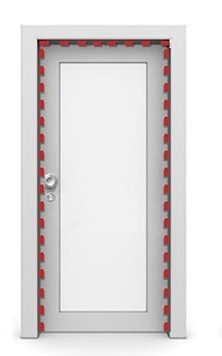
Look for light and feel for moving air around the perimeter. Check whether the gaps are even. Real doors and frames are often slightly out of square, so measure in several places. Also check whether the door rattles when it is closed. Sometimes the latch needs adjustment before any seals are added.
The bottom
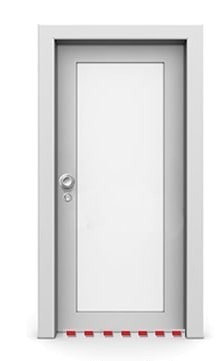
Measure the distance between the door and the surface beneath it at the left, centre and right. Then identify what the bottom seal would land on:
- timber
- tile
- concrete
- a metal threshold
- an uneven transition
- carpet
This matters. An automatic drop-down seal needs a hard, reasonably level landing surface. It will not seal properly onto carpet.
The opening direction and available surfaces
Most apartment entry doors open inward. A perimeter seal for an inward-opening door is often installed on the corridor side of the frame - which makes owners corporation approval especially important.
Check the door handle, hinges, closer, latch, threshold and anything else that might interfere with the proposed product. Never cover a fire-door tag or interfere with the self-closing mechanism.
Choose the Right Solution
Option 1: Noise Is the Main Problem
For a suitable, approved door, our preferred acoustic combination is:
- RP78 acoustic perimeter seal for the two sides and top
- RP35 automatic drop-down seal for the bottom
- a treadplate, where required, to create a hard, level sealing surface
Together, these products close the air path around all four sides of the door. That may noticeably reduce voices, lift announcements, draughts, light, dust and smells entering around it.
RP78: sides and top
The RP78 uses an aluminium carrier and silicone seal to close gaps around the perimeter. It covers gaps up to approximately 6 mm and is available for single doors in silver, black and bronze. It is screw fixed. That is one reason why fire-door confirmation and written approval must come first.
RP35: bottom of the door
The RP35 contains a seal that drops automatically when the door closes and lifts when it opens. It can treat bottom gaps from approximately 3–13 mm without dragging across the floor. It is particularly useful where wheelchairs, walkers or prams are used because there is no permanently raised obstruction across the opening. The RP35 must close onto timber, tile, concrete or a threshold plate - not carpet.
When is a treadplate needed?
A treadplate gives the drop-down seal a firm, level surface. It may be needed where the existing threshold is uneven, worn, interrupted or too low for the RP35 to reach consistently. Fitting a treadplate can involve fixing into the threshold or floor. Check permission, fire-door requirements, waterproofing and trip hazards before proceeding.
What this solution will, and won’t do
It can:
- close the gaps through which airborne noise travels
- reduce draughts, smells, dust and visible light
- stop some rattling caused by movement within the frame
- help retain heated and cooled air
It cannot:
- stop footsteps travelling through concrete
- silence a lift motor or building pump
- correct noise passing through lightweight walls or ceilings
- turn a hollow or lightweight door into a solid acoustic door
- guarantee a particular decibel reduction in every building
We would rather say that now than promise you a recording studio and deliver a slightly quieter lift lobby.
Option 2: Draughts Are the Main Problem
If acoustics are not the priority and the door is an ordinary, suitable hinged external door, the External Door Draught Proofing Kit treats all four sides of one door. Most apartments have one main entry door, so the single-door kit is generally more appropriate than ecoMaster's Front and Back Door Kit.
The External Door Kit includes:
- Draught Dodgers for the top and sides
- an RP3 automatic drop-down seal for the bottom
It is designed for uneven perimeter gaps up to 10 mm and bottom gaps up to 16 mm. It is an excellent thermal draught-proofing solution and may reduce some noise, but it is not our first choice where acoustics are the main objective.
The kit includes screw-fixed draught excluder to the bottom of the door and will need to be installed on the corridor-facing side. Do not order it for an apartment entry door until fire-door status, installation location and permissions have been resolved.
Option 3: The Door Opens Over Carpet
An automatic seal cannot land directly on carpet. If no rain or external weather reaches the door, the RP1 Fluffy Roller may be the practical alternative.
It hangs from two small hooks on the inside face of the door (so not visible externally) and rolls across carpet or changing floor levels as the door opens.
The RP1 is:
- inexpensive
- easy to remove
- suitable for many carpeted applications
- useful for reducing air movement beneath the door
It is not:
- a weather seal for rain-exposed thresholds
- equivalent to the RP35 for acoustic performance
- suitable for installation on a fire door unless specifically approved for that door assembly
Option 4: The Gaps Are Small and You Need a Subtle Solution
For small perimeter gaps on a suitable ordinary door, EMV Slim Line Seal may be useful. It is a clear, adhesive V-shaped strip that can be installed discreetly around the door jamb without bulky foam. EMV is a low-cost draught treatment. It may help with whistling and rattling, but it is not a substitute for the RP78 where acoustic performance is the main goal. Adhesive does not mean approval-free. Check the fire-door, gas and permission questions first.
Measure Before You Order
Please do not guess. Apartment doors are remarkably committed to being different from one another.
Record:
- door width
- door height
- perimeter gap at several points
- bottom gap at the left, centre and right
- opening direction
- whether the door is timber, metal or another construction
- whether the frame is timber or metal
- what surface lies beneath the closed door
- whether the closer and latch operate properly
- available clearance around the handle, hinges and frame
For an RP35, select the correct length carefully. It can be cut down within specified limits, but cutting it shorter than the next available size can damage the internal mechanism.
If you would like ecoMaster to help identify the likely solution, send us:
- A photograph of the whole closed door from inside.
- A photograph of the whole door and frame from the corridor, where permitted.
- Close-ups of the top, sides and bottom gaps.
- A photograph of the threshold or carpet beneath the door.
- The measurements listed above.
- Confirmation from the building manager about fire-door status and approval.
A handful of useful photographs beats a twenty-message exchange about “a fairly normal sort of door”. Yep, we’ve had that as a description. 🆘
A Note About Corridor Smells and Air Pressure
Sealing gaps may reduce cooking smells, cigarette smoke, dust or other corridor air entering around the door. But strong or persistent airflow can also indicate a broader building-pressure or ventilation issue. If the door is difficult to open, air rushes through the gaps, smells are widespread or smoke is entering from common areas, report it to the building or owners corporation manager. Door seals should not be used to disguise a problem with communal ventilation, smoke control or fire systems.
Are You a Renter or Rental Provider?
Victorian rental standards are changing. From 1 July 2027, draught proofing will be required on external doors, windows and unsealed wall vents when a new rental agreement begins or an existing fixed-term agreement becomes periodic.
Where the property has gas appliances, a licensed plumber must complete the required gas safety check before draught-proofing work, and that check must be less than six months old when the work is completed. Draught proofing must not proceed if the check identifies an unflued or open-flued gas appliance.
Apartment entry doors add the further questions of fire-door compliance and owners corporation control. Rental providers and property managers should resolve these matters before choosing products or arranging work.
Read our Victorian Minimum Rental Standards Guide
What Should I Do First?
Do not start with the product, start with the door.
Today
- Ask whether it is a fire door.
- Check for gas appliances inside the apartment.
- Find out who controls the door, frame and threshold.
- Work out whether the main problem is draught, noise, smells or all three.
- Measure every gap, not just the most obvious one.
Then choose the pathway
- Noise is the priority: investigate RP78 + RP35 + a treadplate where required.
- Draughts are the priority: investigate the External Door Draught Proofing Kit - and if externally fitted is acceptable.
- The door opens over carpet: investigate the RP1 Fluffy Roller - and if internally fitted is acceptable.
- The gaps are small: investigate EMV Slim Line Seal, which sits discreetly within the door jamb.
- Noise is structural: speak to the owners corporation or an acoustic consultant.
The fine print! Every product recommendation is subject to fire-door suitability, gas safety and the necessary permissions.
Need Help With the Rest of the Apartment?
The entry door may be the loudest or draughtiest opening, but it is rarely the apartment's only comfort problem.
Go to Smarter, More Comfortable Apartments for practical help with aluminium windows, secondary glazing, summer sun, top-floor insulation, heating, cooling and energy bills.
Or explore ecoMaster's Draught Proofing Information Hub to work systematically through the rest of your home.
FAQs
Will sealing my apartment door stop all corridor noise?
No. It can reduce airborne sound travelling through gaps around the door. It cannot stop structural and impact noise travelling through the floor, walls or ceiling.
Can I install an RP35 over carpet?
No. The RP35 needs a hard, level surface. Consider a suitable treadplate or, where weather does not reach the opening, investigate the RP1 Fluffy Roller.
Is the RP78 suitable for every apartment fire door?
No product should be assumed suitable merely because it has an acoustic or BAL rating. Obtain building approval and qualified fire-door advice for the specific door assembly before installation.
Can I fit the products myself?
Many ecoMaster products are designed for DIY installation on ordinary doors. A fire-rated apartment door is different. Do not modify it yourself unless the precise work and product have been confirmed as suitable and all required written approvals are in place.
Can a renter draught proof an apartment door?
Permission requirements depend on the product, the rental property, owners corporation rules and whether the door is a fire door or common property. Gas safety must also be resolved. Ask precise questions and obtain written consent where required.
Why not just use a door snake?
It treats only one of the door’s four sides, moves whenever the door opens and does little about gaps around the top and sides. It can be a useful temporary test: if the room becomes noticeably quieter when you put it down, the bottom gap matters. But it is rarely the complete solution. It is also a pest to keep putting back every time the door is opened.
Recent Comments