CASE STUDY > Too hot in summer too cold in winter
This home is a timber framed construction clad in pine weatherboards with timber floors supported by concrete stumps.
The roof is a standard attic style with broken hip verandah constructed with roof trusses and metal cladding.
The owners found the home to be very hot and uncomfortable in summer, and despite extensive heating and expense the house remained stubbornly cold in winter.
There were a number of factors contributing to the hot and cold issues.
1. Draught Proofing. External doors were fitted with weather stripping that was brittle and non-compressive and was not making contact with the door edges. Draught excluders were not fitted. All window and door architraves exhibited small unsealed cracks between the architrave and the wall plasterboard. All exhaust fans were unsealed.
2. Lighting. Gimballed halogen down lights, and incandescent vented down-lights, allowed the air to flow from the living space to the attic space due to the required uninsulated area to be left around the lighting for fire safety.
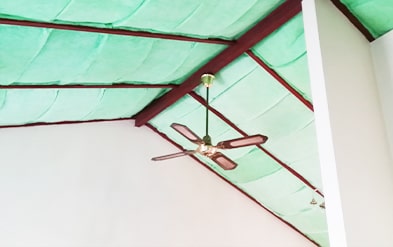
3. Ceiling Insulation. The ceiling had inconsistent and ineffective insulation. The cellulose and fibreglass insulation batts were loose and there was no insulation at all in other parts.
4. Flooring. The floor comprised structural chipboard. All flooring was in sound condition but was not fitted with any form of insulation.
5. Wall Insulation. The walls were fitted with the usual reflective laminated foil house-wrap. The south and western walls were fitted with fibreglass batts. The weatherboard construction made it impossible to determine the thoroughness and quality of the foil installation. The quality of the installation of the foil has a large bearing on its insulation effectiveness.
6. Windows and Doors. All windows were timber framed awning style with standard clear annealed glazing. The frames and opening sashes were in good condition. Sliding glazed doors and glazed French doors were entry doors to the verandah. The front door was timber framed with side lights on either side.
This home had a 1 star energy rating.
The following solutions were implemented
1. Draught Proofing
| a) |
Draft-Stoppa devices were fitted to the existing exhaust fans. A coupling adapter was constructed to enable a Draft-Stoppa to be fitted to the range-hood exhaust. |
| b) |
The existing wall vents were sealed. |
| c) |
All gaps and cracks were sealed |
| d) |
Architectural weather stripping and draught excluders were fitted to the external doors |
| e) |
Brush style draught excluders were fitted to the internal laundry and the bathroom doors. |
| f) |
Ceiling vents of the air movement system were sealed and the system was disabled. |
Draught proofing is often the most cost effective improvement that can be made to a home to increase the comfort level and reduce energy consumption. It is also a necessary precursor to effective insulation of a home.
2. Lighting
To properly insulate the ceiling and to restrict air flow to the attic space some existing down-lights were replaced and other down lights were insulated with Isoliteâ„¢ Down-light Guards.
3. Ceiling Insulation
The current insulation was ‘made good’ around the down-lights and a complete layer of R1.5 polyester insulation batts were fitted over the top of the existing insulation.
As with all insulation, careful and thorough installation is required to ensure maximum benefit.
Ceiling insulation is the single most effective insulation you can have in your home. Effective and substantial ceiling insulation will make the greatest single improvement to the comfort of your home
4. Flooring
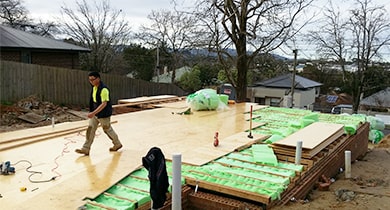
The sub-floor in the living areas was insulated with ecoUnderFloor combining two different products to provide the most effective year round insulation. The greatest benefit of under floor insulation is mostly felt in winter time.
5. Wall Insulation
The only way thermal effectiveness could be improved in the walls is to insulate between the timber cladding on the outside of the home and the internal plasterboard.
ecoWall will bring a high level of insulation to the walls, in this case making the walls 10 times more thermally effective than the standard cladding.
6. Windows and Doors
All doors with the exception of the glass sliding doors are to be ecoGlazed. The glass sliding doors cannot be ecoGlazed as they would become too heavy and the doors would become too wide to slide. Installing heavy drapes with pelmets would provide a similar effect.
This client has taken a phased appoach to thermal proofing their home. Once all the improvements are completed this will be a 5 star rating home.
Contact ecoMaster to help you find the right solution for your home.
Find out how we can help you
Call 1300 326 627 or email
ecoMaster
|