


Why We Are Big Fans of Big Ass Fans
Ceiling fans do not get nearly enough credit.
They are sometimes treated as the thing you use when you do not have air conditioning. In reality, a good ceiling fan is one of the simplest and cheapest ways to improve comfort in both summer and winter, even in a home with excellent heating and cooling.
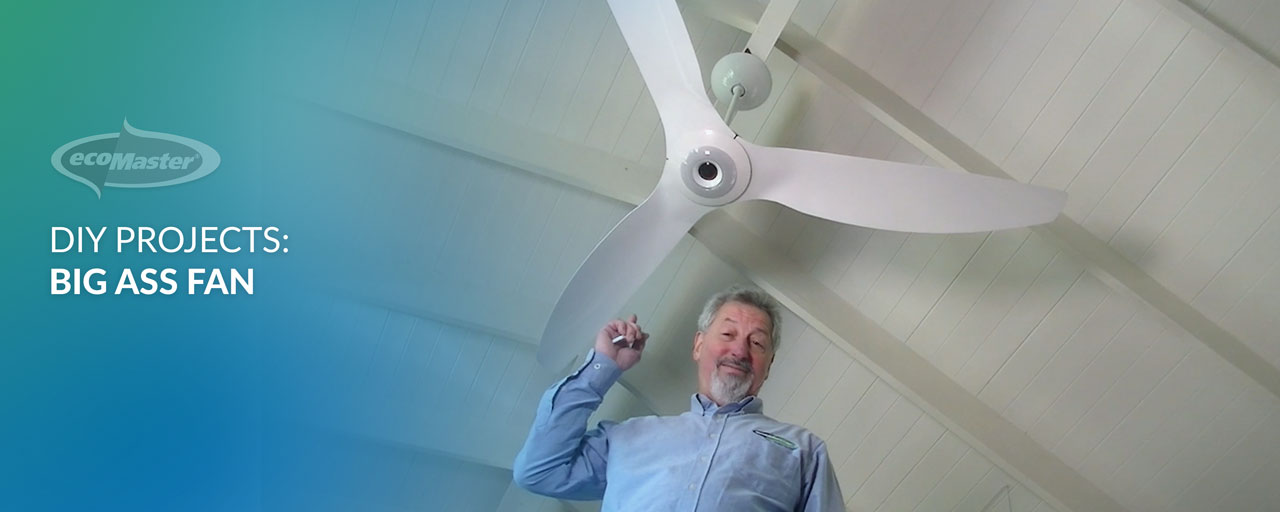
The fan you see above us is a Haiku ceiling fan, made by a company with the rather unforgettable name of Big Ass Fans.
This is a large room, so we needed a fan capable of moving air effectively across the whole space. We previously had an ordinary ceiling fan here, but the quality was disappointing. It wobbled, it was noisy and it never really moved enough air to justify its presence. Eventually, we replaced it with the Haiku Big Ass Fan.
It was not the cheapest option, but it is an extraordinarily well-designed and well-made fan. More importantly, it does the job a ceiling fan is supposed to do: it moves a large volume of air smoothly, quietly and evenly.
Why Ceiling Fans Work So Well in Summer
A ceiling fan does not actually lower the temperature of a room. What it does is move air across your skin. That moving air helps your body release heat and makes the room feel cooler, even though the air temperature itself has not changed.
The Australian Government estimates that a fan can make you feel about 3°C cooler while costing only around two cents an hour to run. The important qualification is that the moving air needs to reach you. Whilst the Government indicates there is little benefit in leaving a fan running in an empty room because the fan is cooling the people and not the room; our personal experience is that the air in a room does not stratify with the fan running. So we have left our Big Ass fan running since 2016 and there is just 0.5 degree difference between the ceiling, walls and floor temperature. (Yes, we do turn it off when we clean it, and when we are shooting videos!).
In mild summer weather, that breeze may be all you need. Instead of switching on the air conditioner, you can turn on the fan and feel comfortable almost immediately.
On hotter days, the fan can work alongside air conditioning. The moving air may allow you to set the air conditioner a little higher while still feeling comfortable. That matters because every additional degree of cooling can increase the energy used by an air conditioner by between 5% and 10%.
A ceiling fan therefore gives you several options:
- use the fan instead of air conditioning on milder days
- use the fan first and delay turning on the air conditioner
- use the fan with the pre-cooling and pre-heating options in place
- turn the air conditioner off once the room has heated / cooled and continue using the fan
That is a great deal of comfort from a relatively small amount of electricity.
Fans Are Useful in Winter Too
Most people think of ceiling fans as a summer product, but they can also improve winter comfort.
Warm air rises. In a heated room, particularly one with a high ceiling, a layer of warm air can collect near the ceiling while the people sitting below remain cold. Without air movement, you can end up paying to heat the top of the room.
A reversible ceiling fan helps redistribute that warmth. In winter mode, the fan runs in the opposite direction, drawing cooler air upwards and gently pushing the warmer air out towards the walls and back down into the occupied part of the room.
The idea is not to create the strong downward breeze you want in summer. You want slow, gentle air circulation that mixes the air without making the people underneath the fan feel cold.
The Australian Government specifically recommends reversible ceiling fans to circulate warm air and improve the effectiveness of heating in winter.
This is particularly useful in:
- rooms with high or raked ceilings
- large open-plan living areas
- homes heated by wood fires
- rooms where the heater is located on one side
- spaces that are warm near the ceiling but cold at sitting height
A fan does not create any additional heat. It simply helps you get more useful comfort from the heat you have already paid for.
Why the Haiku Is Different
There are plenty of inexpensive ceiling fans available, but they are not all equally good at moving air.
A poor-quality fan may wobble, click, hum or move surprisingly little air. It can become so irritating that you avoid using it, which makes the inexpensive fan a fairly expensive ceiling decoration.
The Haiku is different. Its airfoils are designed to move air efficiently rather than simply spin around. Its brushless direct-current motor provides precise control, while the fan’s balancing system is designed to prevent the wobbling, ticking and mechanical noise commonly associated with cheaper fans. That engineering matters most at low speeds. It draws as little as 2.4W at low speed.
A fan that can move air gently and quietly is far more useful than one that must be turned up until papers start flying off the table. In summer, the Haiku can create a broad, comfortable breeze rather than an aggressive blast directly underneath it. In winter, it can circulate air slowly enough to redistribute warmth without making the room feel draughty.
Our fan is operated by remote control and includes an integrated light, which can also be dimmed. That keeps the ceiling uncluttered and allows the one fitting to provide both air movement and general lighting.
But the feature we notice most is simply the quality of the air movement. Stand underneath it in summer and you immediately feel cooler. Run it gently in winter and it helps bring warmth back down into the part of the room where people actually live.
Choose a Fan to Suit the Room
Fan size matters. A small fan in a large room may spin enthusiastically without moving enough air across the occupied space. The answer is not to run it faster. A properly sized fan can move more air across a wider area at a lower and quieter speed.
Position is also important. For summer comfort, the fan should generally be above the part of the room where people spend their time—such as the bed, dining table or lounge area. That is where its cooling effect will be most useful.
In a large room like this one, installing a larger, better-designed fan in the middle of a large room made an enormous difference to the entire room.
A Fan Is Not a Substitute for a Better Home
A ceiling fan will not stop heat entering through unshaded windows. It will not replace insulation, draught proofing or effective window coverings. It will not make a poorly performing home thermally efficient.
Those improvements reduce unwanted heat loss and heat gain at the building envelope.
A fan performs a different role. It helps your body feel cooler in summer and helps distribute warmth more effectively in winter. Put those things together and the whole home works better.
That is why we are such fans of fans.
And after living with the Haiku, we can say that Big Ass Fans is not just a memorable company name. This is an exceptionally effective, quiet and beautifully engineered piece of equipment that earns its place in the room all year round.
NOTE: We have no commercial interest in Big Ass Fans. We just love their fans.
Recent Comments