



A house can look perfectly clean and still have pretty poor indoor air quality.
You can vacuum. You can open a window for five worthy minutes. You can light a candle called something like Ocean Drift & Emotional Clarity. And still end up with a home that feels stuffy, smells musty, fogs its windows, and leaves you waking with a headache or lousy sleep.
That’s because indoor air quality is not about whether your house looks tidy. It’s about what’s building up in the air, what’s drifting in from outside, and what your home is trapping when it should be getting rid of it.
And no - the answer is not always “just open a window”.
Sometimes that helps. Sometimes it lets in pollen, bushfire smoke, traffic fumes, dust, noise, or a blast of freezing air that makes the house less healthy and less comfortable. What you actually want is a home that feels fresh, dry, calm and comfortable.
Fresh air, yes. Random draughts, no.
Why indoor air quality matters
Poor indoor air quality does more than make a room feel a bit stale. It can affect how you sleep, breathe, think and feel the next day.
If carbon dioxide builds up in occupied rooms - especially overnight, or in closed-up rooms used for long stretches (like an office or study), the air can start to feel heavy and under-ventilated. That’s when people wake with a headache, dry mouth, fuzzy head, interrupted sleep, or that “why am I still tired?” feeling.
The CSIRO defines indoor air quality as the indoor air conditions that affect the health and well being of occupants, including stuffiness, ventilation, odours, contaminants, humidity and temperature. So if a room feels stale, damp, irritating or hard to breathe in, that absolutely counts.
Why homes get stuffy
Most homes are not simply “too sealed” or “too open”. They are bad at the two things that matter most:
- keeping unwanted air out
- bringing fresh air in properly
So instead of healthy ventilation, you get random leakage.
That means:
- cold air sneaking in through gaps
- dust, smoke and pollen drifting inside
- moisture hanging around too long
- warm air escaping in winter
- and somehow the room still feels stale
That’s why a home can be draughty and stuffy at the same time.
The CSIRO boils indoor air quality down to three big factors: the quality of the outdoor air, the amount of outdoor air brought in for ventilation, and the indoor pollutants being generated inside.
That’s a much better way to think about it than “open a window and hope for the best”.
What’s actually polluting the air?
More than most people realise. According to the CSIRO, indoor air pollutants can come from:
- cooking
- unflued gas heaters
- building materials and furnishings
- carpets and soft furnishings
- printers and office equipment
- cleaning products and perfumes
- dust mites and indoor pets
- outdoor pollution entering indoors
So if you’ve ever wondered why your house feels stuffy even when it’s clean, this is why. A house can be spotless and still have stale air, excess moisture, combustion by-products, or off-gassing from materials.
A quick technical reality check
The CSIRO article includes a handy Table 1 Indoor Air Pollutants and Maximum Limits in Indoor Air Concentrations. A few standouts:
- Carbon dioxide (CO2): 850 ppm over 8 hours — a useful indicator of whether ventilation is acceptable in occupied spaces, in the absence of combustion sources
- Nitrogen dioxide: dominant sources are unflued gas heating and cooking
- Formaldehyde: common from wood-based products like MDF, particleboard and plywood
- PM2.5 / PM10: linked to cooking, heating, smoking and polluted outdoor air
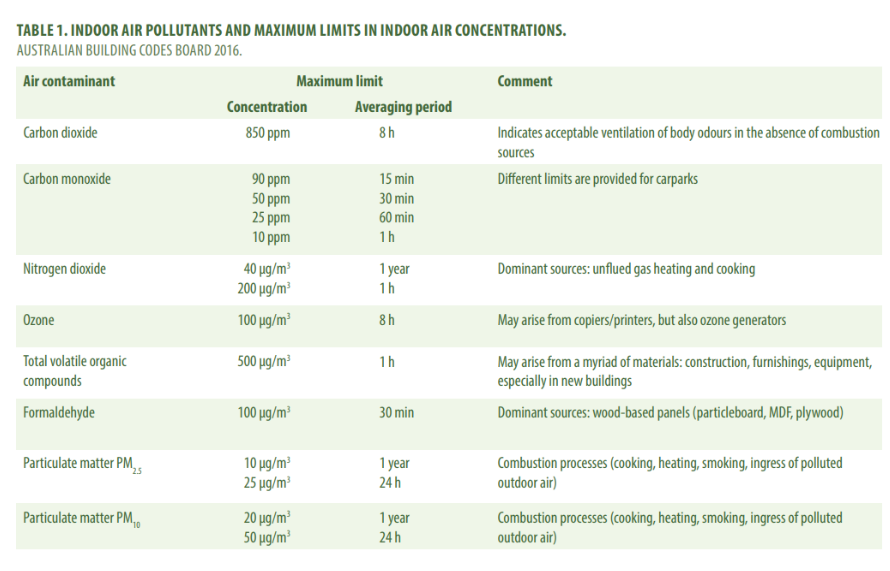
Reference: Csiro document here.
You do not need to memorise the numbers. The useful takeaway is this: indoor air problems are not just about “stale air”. They can involve moisture, particles, chemical emissions and combustion products too.
The signs your indoor air quality might be a bit rubbish
You do not need lab equipment to notice the basics. Common clues include:
- waking with a headache, fuzzy head or poor sleep
- rooms that feel stuffy or “used”
- wet windows in the morning
- musty smells
- mould on frames, corners or curtains
- damp-feeling rooms
- smoke, dust or pollen getting in easily
- rooms that overheat quickly and stay uncomfortable
If your home has more than one of those, it is handing you a to-do list.
What should you measure?
If you want to stop guessing, track these:
CO2
Useful for spotting stale, under-ventilated rooms.
Humidity
Useful for spotting condensation and mould risk.
Temperature
Important because hot, cold or unstable rooms are harder to ventilate well.
PM2.5
Helpful if bushfire smoke, dust or traffic pollution are part of the picture.
If you only measure two things, make it CO2 and humidity.
What causes condensation on windows?
Warm, moist indoor air hits cold glass. The moisture turns to water that results in streaming glass, damp sills and mould.
The CSIRO notes that moisture indoors comes from breathing, showering, washing, drying clothes, cooking, evaporative coolers and unflued gas heaters. If ventilation is low, that moisture condenses on cool surfaces and can lead to mould.
So if you are asking what causes condensation on windows, the answer is usually:
- too much indoor moisture
- not enough extraction
- not enough planned ventilation
- cold glass
- poor insulation
And these are pretty much the same reason why mould keeps coming back. Because mould is usually a symptom, not the root problem. You can wipe it off. Spray it and feel briefly superior. Then it comes back because the conditions that feed it are still there.
The answer to how to stop mould in the house is not just “clean it better”. It is:
- reduce moisture
- improve ventilation
- warm cold surfaces
- fix condensation
- stop uncontrolled leaks making rooms colder and wetter than they need to be
The indoor air villains people forget about
Two deserve special mention:
Unflued gas heaters
The CSIRO and ecoMaster are in furious agreement here: unflued gas heaters can emit dangerous nitrogen dioxide, and if they are not correctly installed and maintained, carbon monoxide as well. They also add water vapour, which can worsen condensation.
Cooking
Cooking generates steam, smoke and combustion products. The CSIRO and ecoMaster recommend efficient rangehood extraction vented outdoors. If your rangehood just makes a noise and moves grease around emotionally, it may not be doing enough.
How to improve indoor air quality without making the house draughty
Good indoor air quality is not about making your home leakier.
It is about making it less random.
Here’s the fix path:
1) Seal the unwanted gaps
If smoke, dust, pollen and cold air are sneaking in around windows and doors, that is not healthy ventilation. It is uncontrolled leakage. Go here to learn all about draught proofing
2) Get moisture out at the source
Bathrooms, laundries and kitchens need proper extraction to outdoors. Steam should not be wandering into the rest of the house looking for trouble.
3) Warm the cold surfaces
Cold glass is a condensation magnet. Better glazing performance helps keep the inner surface warmer and drier. Go here to learn about secondary glazing options
4) Control harsh sun
If rooms overheat through the glass, they become harder to ventilate comfortably and more likely to feel stale and oppressive. Go here to learn about the best way to shade a window
5) Improve insulation
Cold ceilings, cold floors and cold surfaces make moisture and comfort harder to manage. Go here to learn about insulation
6) Ventilate deliberately
Open windows when outdoor conditions are good. Use cross-ventilation when it helps. Use extraction properly. But do not rely on cracks and gaps to run the house for you.
That’s the difference between a home that feels fresh and calm and one that feels draughty and still weirdly stale.
What about plants and air purifiers?
Plants are lovely. Keep them if you enjoy them.
But the CSIRO notes that while some plants can remove contaminants in lab conditions, their real-world impact on indoor air quality is tiny — about the equivalent of adding a very small amount of ventilation. In plain English: they are not going to rescue a damp, stuffy house.
Air cleaners can help in the right situation, but they need to treat a substantial amount of air to make a serious difference. Again: useful in some cases, not magic.
Where to start
Indoor air quality can feel like a big, fuzzy problem - but in real homes, it usually shows up room by room. A stuffy bedroom. A damp bathroom. A sunny living room that overheats and never quite settles. A hallway that drags dust, smoke and cold air through the rest of the house. That’s exactly why we created The Comfort Series: Room-by-Room Rescue. Instead of trying to “fix the whole house” in one heroic weekend, you tackle the real trouble spots one at a time, in the order they actually affect comfort. Start with the room that feels worst, fix what the room is telling you, and the rest of the house gets easier from there.
Sources for the technical points in this article include the CSIRO Indoor Air Quality Building Technology Resource, including its definition of indoor air quality, pollutant sources, Table 1 benchmarks, and advice on combustion, moisture, ventilation and contaminants.
People Also Ask:
⇒ Where can I learn more about this from an industry expert?
ecoMaster has been working in the energy efficiency / retrofit arena for over 20 years. During that time we learnt an enormous amount about diagnosing issues, distinctions on various products as well as developing the best installation practices. We have done the research, so you don't have to. All that information has now been condensed into a series of ecoMasterClasses. Click here to gain access.
⇒ Why does my house feel stuffy even when it’s clean?
Because poor indoor air quality is not just about dust or mess. A clean-looking home can still have stale air if carbon dioxide is building up, moisture is hanging around too long, or the house is not ventilating properly. It can also happen when the home is leaky in all the wrong places - letting in dust, smoke or pollen - but still not getting enough fresh air where it actually matters. A house can be draughty and stuffy at the same time. Annoying, but very common.
⇒ What causes condensation on windows?
Condensation happens when warm, moist indoor air hits cold glass. The moisture turns into water, which is why windows are often wet in the morning. Common causes include breathing overnight, showers, cooking, drying clothes indoors, poor extraction, and cold glazing. Condensation is not just a window problem, it is a sign that your home has too much indoor moisture, cold surfaces, or not enough planned ventilation. Left alone, it can lead to mould and musty smells.
⇒ How do I improve indoor air quality without making my house cold?
The trick is to stop relying on random gaps for ventilation. Seal the unwanted leaks that let in cold air, dust and smoke, then bring in fresh air more deliberately. That means managing moisture at the source, using extraction properly in wet areas, reducing condensation risk by warming cold surfaces, and ventilating when outdoor conditions are good. Good indoor air quality is not about making your home leakier — it is about making it less random
What’s Next?
We hope this article has helped you learn about ways to improve your indoor air quality. This in turn will help you on your energy and thermal efficiency retrofit journey to make your home more comfortable all year round, and reduce your costs and carbon emissions.
Still dealing with cold glass, condensation or overheated rooms? Read our Ultimate Guide to Window Coverings next.
If you found this article helpful, then please subscribe to our YouTube Channel. You’ll find many more helpful “How To” videos there. You can also follow us on Facebook and Instagram to stay in the loop. For more great information on how to make your home more energy and thermally efficient subscribe NOW to ecoBites. ecoBites are free bite size chunks of the latest energy efficiency information making it quick and easy for you to absorb.
Recent Comments